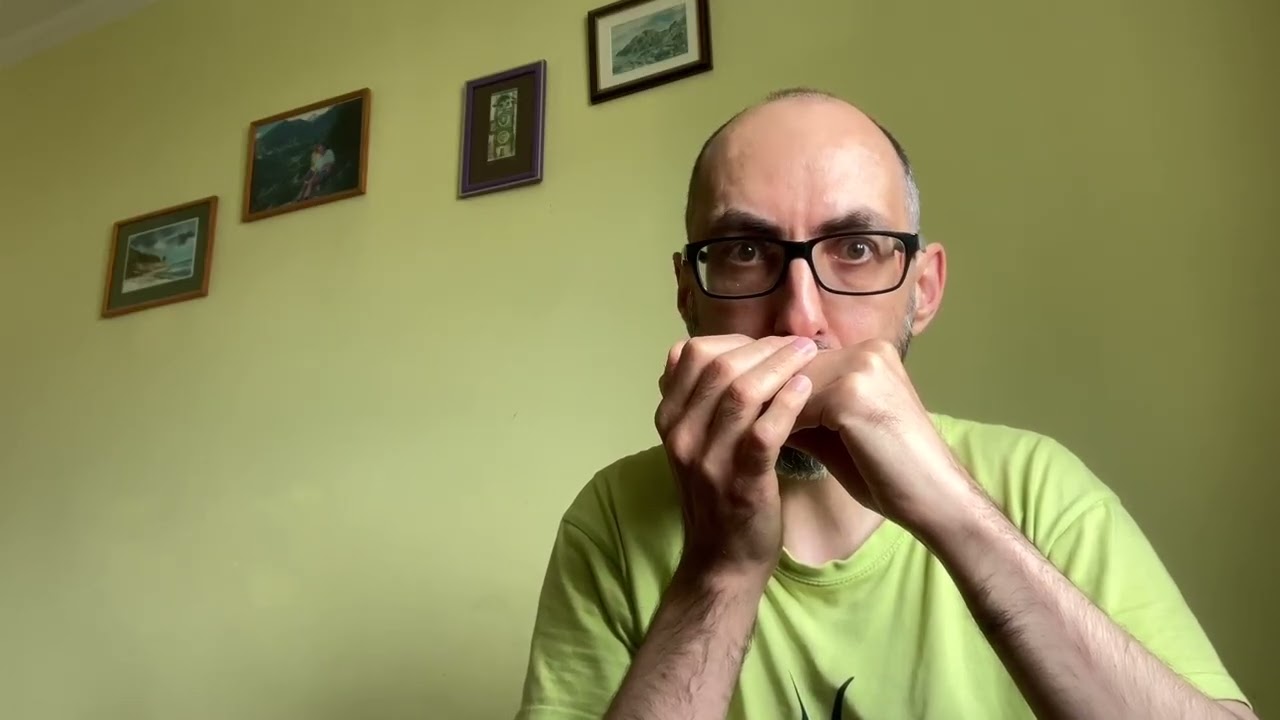
That was pretty good. The timing really is also pretty good. My suggestion is to start working on “smoother” transitions from one note to the next. Currently it sounds almost as if you had patched together recordings of each note rather than transitioning smoothly from one to the next. Try to keep the volume/blowing pressure more constant during the duration of each note: as it now sounds as if you attack each note rather strongly and let its intensity drop off before going on to attack the next note.
I hope that is clear and helps you somewhat. Keep going, because your playing is better than I expected.
@Carlos1 Thank you so much for your feedback; I really appreciate it. Yes, now I understand why my recording doesn’t sound like those of other, more experienced harmonica players.
Could you give me some tips on how to “fix” this problem? How can I transition smoothly from one note to the next? Do you know of any resources online or have any advice on how I can practice this?
[Edited]
P.S. I did some searching online, and from what I found, I’m doing it wrong because I play each note on a separate breath and also “attack” it with articulation. From the advice I found (though I can’t find any specific, detailed tips), the conclusion is to play several notes on a single breath.
I recorded a spontaneous video of my first attempts (unedited).
Please let me know if I’m on the right track and if my posture and other aspects of my game are correct. If not, which elements should I improve and how?
Try whispering the notes when you articulate them so they sound softer. Like you said no need to play every note. Try playing two or three notes that are next to each other from the articulation of the first note.
Much better! You are on the right path now. Keep working on that in the way that @Dai also suggested. This advice can be applied to both blow and draw notes.
Also remember that there definitely are times where your original style of playing is also good to use – that effect is sometimes more appropriate than the “smooth method”. With time and experience you will begin to recognize when one or the other style is better to use for this or that phrase or lick in order to achieve a particular mood/feeling/emotion in your song.
Thank you @Dai@Carlos1 for your help. I just listened to Marcin Dyjak’s recordings of these pieces (“Ode to Joy” and “Oh, Susanna”) again, the first one is played “smoothly” (I think the technical term for that is legato), while the second one is played “bouncily” (staccato).
I’ve started practicing the piece “Ode” using this legato technique, but I’m not yet sure how to transition smoothly between inhaling and exhaling (I prefer the terms “inhale/exhale” rather than “draw/blow”) to make the sound flow smoothly. I’ve noticed that this style of playing promotes breathing with diaphragm and that is a good thing
Another problem I’ve noticed is excessive saliva production, which I can’t “get rid of” because I keep the harmonica pressed against my lips the whole time. From what I understand, this “issue” goes away with time and practice, I’ll be produce less and less saliva with time; for now, I’m only able to play four measures of the melody.
I’ve also started practicing “Oh, Susanna”. Today was the first attempt after long break not playing this song.
I recorded it using iPhone SE 3rd gen and Dolby On app, edited in iMovie (cut the beginning and the end when I pushed on/off recording button).
Quality is very good, in my opinion, now I hear how bad I’m sound
I have a few questions:
This song should playing staccato, right?
How can I improve the sound of harmonica? I probably have an “issue” that I’m not always find the right hole correctly and with timing and I force the breath then. Is it my suspicion is correct? I’m not breathing with diaphragm yet, probably.
I know that the tempo is too slow, I’ll be working on it.
I’m able to make out the tune and it seems pretty accurate. To improve tone maybe try to practice isolating notes as you go through your scales.
@Luke suggests the deep mouth and relaxed mouth position which seems to have helped me a lot. Play with individual notes making them sharper and flatter to hear the subtleties in tone.
Excellent!! Now here are replies to your questions:
This song is usually played staccato – but that does not mean that you must play it that way. In fact, it can sound very nice with some lagato use.
As you improve playing single notes your sound will also improve. There is no immediate “Do this now” that will have you quickly playing like a pro. Practice and patience are your friends, so put them both to good use.
The tempo is not too slow. In fact, you can play at whatever tempo you desire and thereby achieve various moods or feelings for this song. I find your tempo to be almost ideal for your skill level. And as your skill level increases you will be able to play it at a higher tempo, if that is what you want to do.
I think you sing note id coming along well. Only thin g I can suggest is place the harp further back so it touches the point it closes of airflow that can creep in between the harp and the back of your mouth. If you feel your single note play is a problem drop your jaw a bit so the opening is smaller. Tilting the harp up helps and no saliva can creep in. If you bend over to the point you will use your diaphragm to refill you lungs. best way I know of it place the harp in and think of the teacher that made life miserable and you finally she her or him outside of school try cussing him out without opening your mouth. Your diaphragm will kick in if you are mad enough. Use several words and do it was force.
Hi everyone, my latest challenge is I need to learn the brass riff on I Like It Like That by Pete Rodriguez - I don’t think it will be too difficult but I was wondering if anyone could tell me which key harmonica I should use. I’m working off the original recording, no key change.
Hay all, working on accompanying a full band on sweet home chicago. There are so may covers of this song that I am having a tough time choosing the direction to go. Maybe you guys can post your best versions of sweet home chicago to help motivate and inspire me? Thanks Eric
Don’t overthink it bro. Do what you FEEL! You know what sounds best to you. Don’t think about “what do other harmonica players like.” What makes YOU happy. That’s how to travel the artistic path.
Lots of -2" -2 and lots of -45 trills. Make it DIRTY baby.
Done it hundreds of times, some of them better then others. What I am looking for is a muse to slightly change up the call and response I normally do. . I feel that’s safe and I wanna test my self. Steel sharpens steel! Watched all the YouTube videos I could find. Next logical step ask the community, they have not let me down yet! Love it here!