I’m trying to figure this out, can somebody give me a clear explanation? Thanks.
Stefano
I’m trying to figure this out, can somebody give me a clear explanation? Thanks.
Stefano
Figure what out, which harp to play?
Key of A First position uses a key of A harp. In key. Straight harp. Major scale.
Key of A Second position uses a D harp. 5 half steps up. Cross harp. Mixolydian mode and the Blues scale.
Key of A Third position uses a G harp. One whole step down. Dorian mode. Minor blues scale.
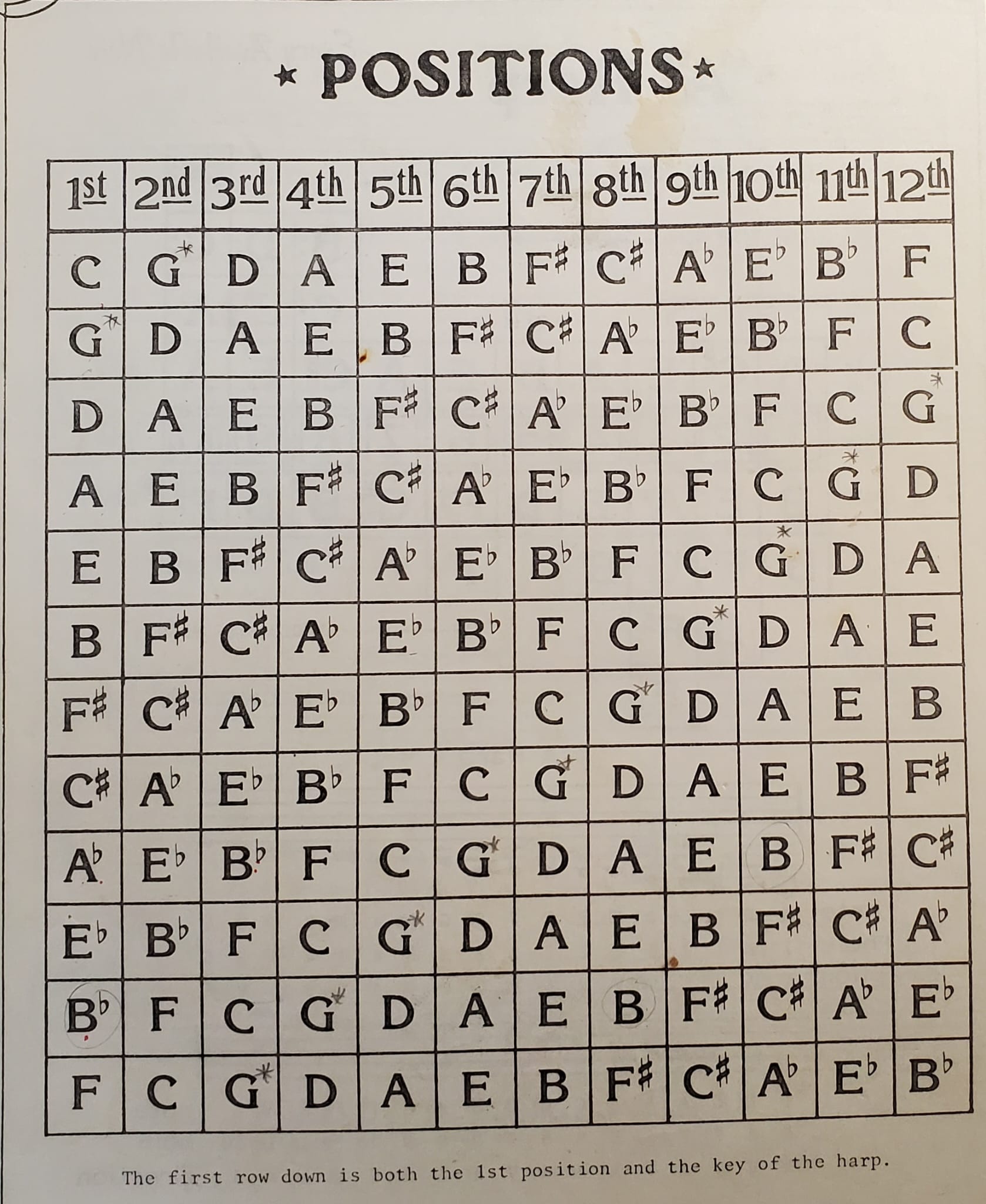
Here’s a chart from Charlie Musselwhite’s harmonica book The Harmonica According To Musselwhite, 1979 Kicking Mule Publishing Inc.
The chart is a little confusing to me, but they must have thought about it and determined this chart layout to be the best way to communicate the positions.
For the example I gave, Key of A, you search for the diagonal A’s under each position and then look to the first column to find the correct harp.
Look at A on the 3rd line down under 2nd position, look to first column to find D is the harp to play for A second position. 3rd position column, 2nd row, look to the first column, and it’s a G harp for third position on an A harp. 4th position column, first row, you play a C harp in the key of A. Etc.
I believe I’ve explained this correctly. Let me know if you agree.
I play a key of C harmonica, I don’t understand what a position is and how I can change positions (1st to 2nd C to G) sorry I’m a beginner.
I understand your reference chart, thanks a lot for it.
Ciao
Stefano
No need to apologize. Appears you are in a great place here. I think Luke has done a phenomenal job with this website. Glad I found it.
What are you interested in playing for music? I enjoy traditional harmonica blues and not much else.
What drew you to harmonica? What did you hear that caught your ear?
The easiest way I can think of to explain this so you can start playing something now, is to play campfire songs and old cowboy music like maybe Old Suzana in the key of C, first position. I play blues first position. And most blues people do that with an A harp in the Key of A and then they can throw in some second position with a D harp. Cool combination.
If you want to jump right into some second position with a C harp find Little Walters Off The Wall on YouTube and mess around there. Difficult but your ears need training, so check it out.
In second position blues, the notes to play will be draw.
In first position, most will be blow.
I can’t think of third position tune for the C harp. (Duh, try any Little Walter Chromatic tune on YouTube. Blue Light is on YouTube.) That would be a minor tune in the key of Dm. Little Walter Dm tunes are normally played on a C chromatic harmonica, but you can still play along on a C diatonic harp. It’ll be mostly draw notes on the high end and blow and draw on the low end. If you can tongue block octaves, use those on the high end. I’d have to sit here and play 3rd position for a while to give you a better description, so just play by ear.
If you can afford more harps, I’d get a G, a Bb, D, and an A, if you want to play blues. (A Low F would be good at some point, but a Low F will be difficult to bend notes at this time in your learning. Low F notes are bent way back in the throat, whereas a High F bends are almost at your front teeth. Talk to @Luke about this and whether it would benefit you to have more harps at this point in your training.
I’m sure someone will chime in and give you better examples for practice in 1st and 3rd positions for C.
Good luck!
Third position on a C Richter-tuned harp is used to play music in the key of D minor – not Bb (B flat).
Now that our beginner has been totally confused and bewildered, I think it is time for someone with teching skills to jump into this discussion before the poor fellow gives up and moves to a simpler instrument.
The important thing is to learn music, we all make mistakes 
Morning,
Thanks for the songs examples to listen to and for your good explanations.
I think I understand the technical difference, it’s just another way of playing the harp, but why do we need 1st position and 2nd position?
I like playing old western songs and some blues, Luke’s lessons are helping me a lot.
Ciao
Stefano
I agree. On the Charlie Musselwhite chart I have Bb circled from years ago. But of course, one full step down from something to use a C harp would be D. I was looking at a piano, too, so not sure why I convinced myself to write Bb.
Must have been my boomer brain, Carlos1, considering I play Dm blues with a C chromatic harmonica.
Are you an admin at Harmonica.com?
Good question. I guess it’s because someone had one key of harp and decided they wanted to play along in some other key.
I’ve been away from harp for years because, as usual, one becomes overwhelmed by the difficulty of playing harp on stage with regard to finding musicians to back a harp player. Generally, you need a guitar player that prefers to play backing instead of lead, and just about the only place you can find those kinds of guitar players is in California. I live in Tucson, AZ where nowadays we have a few harp blowers playing out, but I would still assess the scene here as not harp friendly.
In my case, playing the blues, different positions allow flexibility and are necessary, really. So, if I wanted to play along to a minor blues song, I really wouldn’t want to play that song in 1st or 2nd position, I’d want to play it in 3rd position to present the right notes and feel to the tune.
I play chromatic a bit. Little Walter style. The Chromatic in C for all the Little Walter recordings is used for D minor tunes, (which is why I’m surprised I set myself up for the Carlos1’s D-day landing).
So if I’m on stage and someone plays a blues song in A, I might prefer to play it with an A harp, 1st position, instead of a D harp, second position, because you get some really cool licks you can play on the low end and you have cool blow bends on the high end. Or I might want to play a G harp if that tune has a minor feel.
Frankly, I’ve never really used C diatonic harps that much. Most pro harp blowers, in general, rarely use C harps unless playing a C chromatic in the Key of D. But there are some blues tunes using a C harp in the key of G, or second position. Off The Wall by Little Walter on YouTube. Mean Old Women by Sonny Terry and Brownie McGhee on YouTube. You should check out Mean Old Women. My first record ever purchased for harp was a Sonny Terry Brownie McGhee record. 1974 would be the time I purchased that record. Christine by Big Walter Horton is also on YouTube using a C harp in second position.
I posted a YouTube video of Sonny Junior (Gary Onofrio) and Sugar Ray Norcia yesterday playing some Sonny Terry style chugging in the Key of E on an A harp, second position, or what the original black guys named cross harp. At one point Sugar Ray grabs a harp and starts playing in 3rd position on a D harp. (Check that for me Carlos1.) After a few bars he probably told himself this isn’t working and went back to the A harp in 2nd position. So positions allow for flexibility, and most likely began when someone had one harp and had to try to make that one harp work over different keys.
Nothing is more fulfilling than playing music, but it can also be a dark experience for some due to interaction with people within the music scene. My daughter was the first 13 year old American to ever be invited to play at the Suzuki Piano Conference in Japan in 2009. Typically they needed to be 14. She accomplished that goal, but didn’t want to play anymore, as she prefers graphic art to music and the people involved with music. And I now have a Kawai Grand piano sitting in my living room, which she plays on rare occasion.
You are in good hands. I see Luke on YouTube on occasion in my feed and I see what he and his people have accomplished here at Harmonica.com. He just might be the next Dave Barrett. Luke will get you to where you want to be.
Final comment, based on a 20 year layoff from harp, is play it for yourself. Even if you can’t make it work out in the world, still play it for yourself. Don’t quit. My love for the harmonica started with hearing one bent note by a guy who had just learned how to bend notes, when I was a Junior in high-school. I walked over and asked WHAT WAS THAT!? I asked for a harp that Christmas. And I received a C harp from my mother.
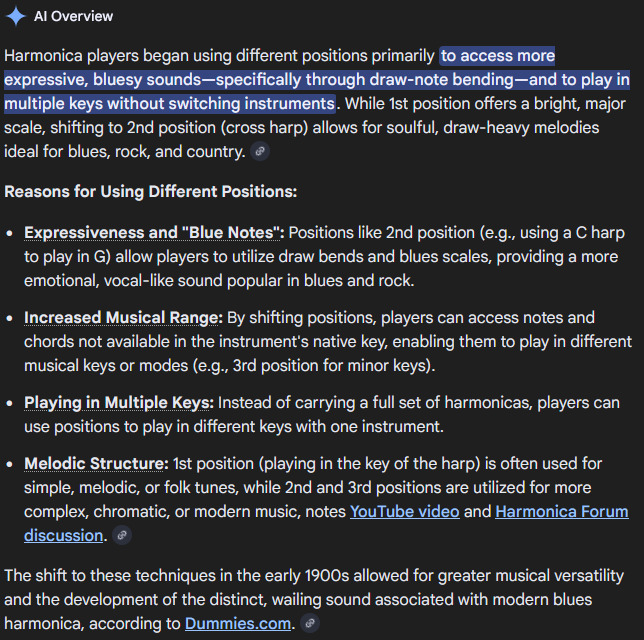
Here is the Goggle AI explanation. Again, probably some black musician with one harp in his pocket. Developed during the early 1900’s.
I like spaghetti westerns and the harmonica playing in them is really cool
Ciao
Stefano
Ever try any of the local Durban Poison? I grew some a couple times. 
Yeah, I wonder which position those are in. Sounds sort of Gypsyish. 3rd? I’ll bet Luke knows.
No, just another harp player. 
It’s not rocket science but it takes some time to get it all straight in your head. Technically, if you can overblow, overdraw or use valves (windsavers), you can play chromatically (all the notes) thereby theoretically playing everything on a C harmonica. It’s just the layout of the notes are not always conveniently located.
The positions (being assigned different numbers) make it a bit more organized and confusing at the same time.
Here’s another way to look at it:
HARP POSITIONS (KEY OF C)
Mode Key Root Note(s) Harp Position
Ionian C major 4B 1st position
Dorian D minor 4D 3rd position
Phrygian E minor 5B, 2B 5th position
Lydian F major 5D 12th position
Mixolydian G major 2D, 6B 2nd position
Aeolian A minor 6D 4th position
Locrian B diminished 3D, 7D 6th position
A position is related to the circle of 5ths (Google a chart for the circle of 5ths)
On the circle of fifths chart, find the key of your harmonica - That is 1st position. The. Move over to the right one, that is 2nd position, and then move over again, 3rd position, etc.
So on a C harp, the positions would be;
1 : C
2 : G
3 : D
4 : A
5 : E
Etc.
@Stefano here’s another great thread on the subject worth reading:
Thanks Luke, reading it