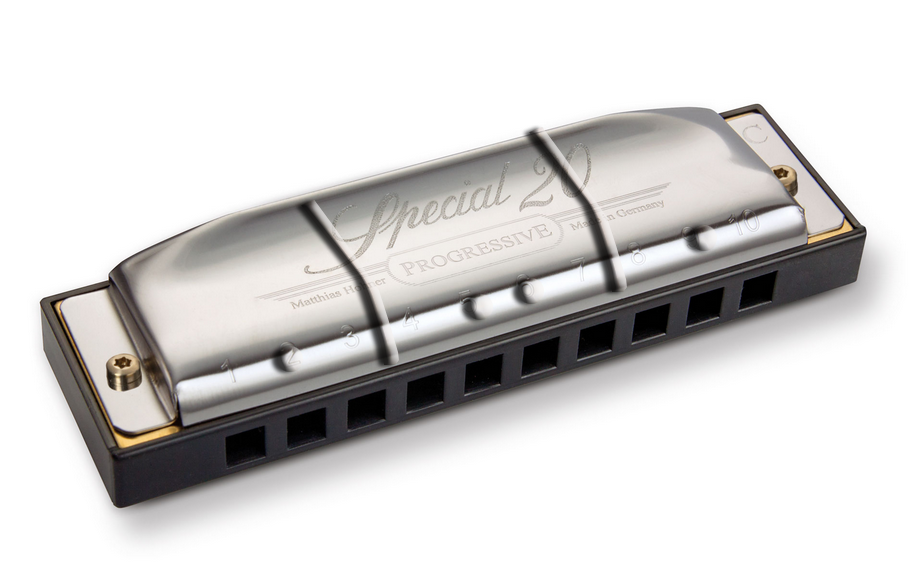
Sacrilege, I know, but one way to keep track of which hole your mouth is over is to make a small notch in holes 4 and 7 (the holes which play the note of the harmonica’s key). In fact, I have filed the outer edges of each these holes so they are a little rough, which would ruin the lips of an expert player, but I am no expert.
Processing: 20250331_163102.jpg…
1 Like
Hi James! Your image isn’t loading, but I’ve initially considered doing something similar (some sort of adhesive tape or making various dents or whatever)
Why Didn’t I do it? I actually sat for a while trying to come up with an answer: I think, it all boils down to the fact that to get good at any tune, you still need that muscle memory. Then again, maybe this is just rationalization - why AREN’T harp manufacturers making small bumps here and there (maybe once per octave)? Surely, this is too obvious a thing to not have been tried - would it adversely affect the lips over prolonged periods somehow?
I mean sure, I’m “proud” to be able to now gauge the millimeter distance from hole to hole, but some sort of guide bumps would make it easier to jump across many holes, which would be useful especially for classical music.
I agree that we should just know where hole 4 is (for example). But I find that, in sessions, where I have trouble keeping up, it helps to have some confirmation of where hole 4/7 is; especially because I often cannot hear myself surrounded by other (louder) instruments. I recently discovered I can hear myself if I cup my right hand so the sound is reflected to my ear (similar to how singers cup their hand over one ear to hear themselves).
2 Likes
Excellent. Even I would find it hard to get lost with so many landmarks around.
Practice is the only way I found to be consistent. I am also a believer in playing you favored haps. The distance can very on several different harps.
1 Like
+1 on PRACTICE. The key is playing often. Eventually, it doesn’t even matter what harp you play on. You can quickly adjust to it.
4 Likes
I have tried but a couple of my harps are so much like a match box that I am getting the key in a crossover, which I prefer. I have tried to like my Oskar but it never gets picked up. Its all about fun and confidence in what you use.
I’ve been learning a particular riff that requires a quick transition from 4 and 6. To make sure I “stick the landing” every time…I hold the harp so that my fingertip provides a backstop. This gives me a tactile reference so I know when I hit the 6.
I like to preface my comments with a declaration that I’m barely a student, let alone a teacher, so this is just my opinion, for whatever its worth. Having a tactile reference as discussed, wouldn’t be much help or any help to me. I suppose there’s naturally some physical point of reference because there’s two ends to the harp and also from our habitual way of holding it. But once Ive learned a song, I’m not thinking about hole numbers, and even if I was, there’s not enough time to process those thoughts in the front of my mind. So, it’s only practice; playing it many times, and then I can relax and just do it. How we remember practiced tunes is still a fascination to me. Intellectually, I kind of understand it, (neurons that fire together, wire together) but emotionally, I’m still amazed that I can just think of a learned song and play it.
1 Like
How long have you been playing PapaCurly? I’m about 5 months into my journey. I’m hoping I will get there. It does feel better every day. But truthfully…I don’t always stick the landing. And sometimes when I think I’ve got a song down on one day, it betrays me the next.
1 Like
Ive been playing for 3 years. I haven’t undertaken any lessons, except for the free videos and advice connected with this forum. At 5 months, you’re only a baby. No wonder you’re not always sticking the landing. I still regularly miss landing a clean note, with one tune in particular that requires a jump from draw 4 to blow 8. I get annoyed with myself when I miss it, but I can adjust quickly and slide over that quarter or half a hole, onto the isolated note.
If I was to draw an ogive graph of my progress over time, it would be steadily trending up from left to right, but it wouldn’t be a straight line, it would be a zig zag line. That is to say, I sometimes play worse this week that I did last week, same as you have lamented. In a couple of years, the frustration you are feeling now, will just be one of those little blips on the graph.
1 Like
Gotta practice it every day. Its the things that are giving you problems that are attacked first. Don’t have to like it but soon it will only be a memory.
Don’t worry if You play wrong note. If You play in 1st or 2nd position there are no wrong notes. Just listen what do You play and continue Your solo even if You miss right channel. No matter if it is improvisation or main theme. If in main theme You played wrong note - You can pretend that You in intentionally play main theme by Your own way
3 Likes
Howard Levy has a you tube about looping that he uses to help not “getting lost on the harmonica”. I started last week working on it and it seems to be helping….another thousand practises and I’ll have it. https://www.youtube.com/watch?v=B6GYKN9-eHo I just can’t imagine Howard Levy getting lost on the harmonica but he says it happens to him!