When I play overblows, they normally play LOUD, but I am a quieter player. Is this normal? I don’t normally incorporate overblows into my playing, so I am not really sure what to expect.
I was wondering if this is a gapping issue. I feel like I need slightly more air pressure to engage an overblow.
I got similar experience. With out-of-the-box harmonicas You will need more pressure to activate overblow and then overblow notes are louder. But if You customize Your harmonica for overblow, then these notes will be easier to achieve and can be quieter.
Overblows works like this:
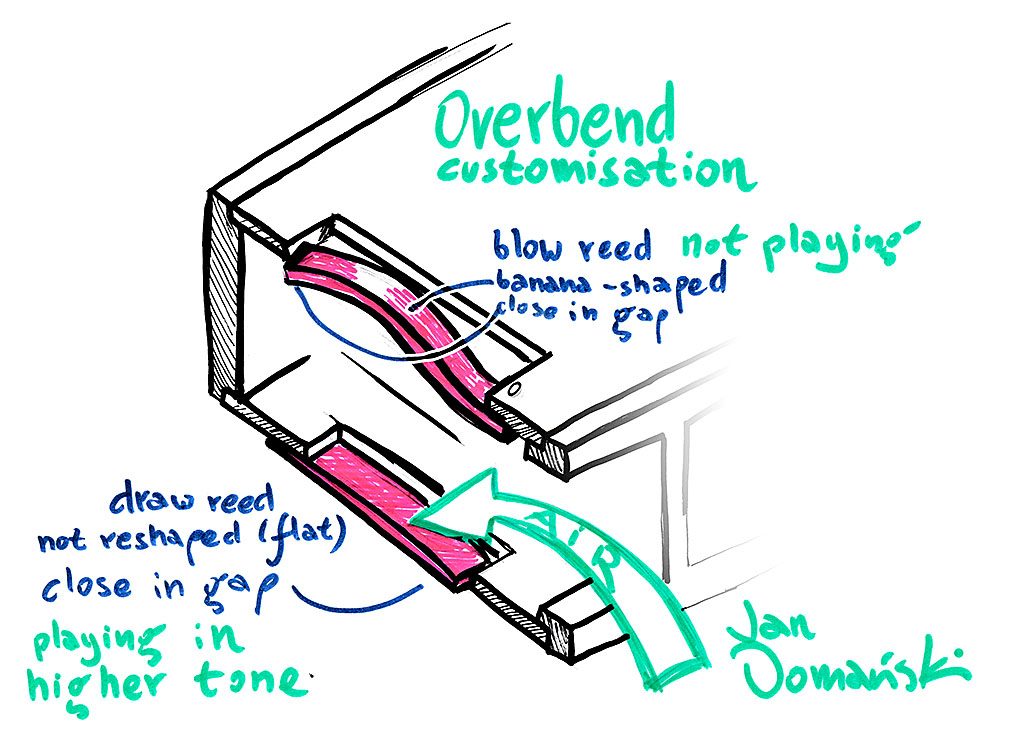
When do You normal blow: then You play on upper reedplate. When You overblow: You redirect air stream to bottom reedplate. Blow reed from upper reed plate deactivates and only lower reed (this which is used for draw) is playing.
My customisation method is to:
Firstly: choose which channels You need to be overblowed. My choice is: 4 (to get Eb on C harmonica), 6 (to get Bb on C harmonica). Thats all. I need only these 2 overblows. on 4th channel to play C-minor scale and Bb to play in clean minor second position. This is usefull to play in Bb key on C harmonica. Bb key is verry nice because You got: dm in third position and gm on 2nd position.
Reshape reeds on upper reedplate to banana shape (arcs) and bend to be very close to gaps in reed plate. Banana arc must have pick (half of reed length) on outside of upper reed plate. Banana-shaped reeds will be easy to deactivate using right air-stream direction when overblowing.
In bottom reedplate I just bend reeds to be close in gap (without reshaping).
@Dk360#1 I don’t recommend worry about Overblows until you have mastered all draw and blow bends with good intonation, and you save up $250+ to buy a Joe Spiers custom harmonica.
As Todd Parrott told me “you can’t drive the Indy 500 in a Toyota Camry, and I can’t play ob’s and od’s the way I do without my Joe Spiers custom harps.” He’s the one that encouraged me to shell out the dough, and I’m glad I did!
But most people start working on ob’s before they’ve mastered all their draw bends and I don’t think that’s a great use of time as the draw bends sound soooooo much better than the ob’s. All right, I’ll get down off of my soap box now.
#2 Great question! I was playing them too loudly a couple years ago as well. But it’s not actually air pressure, but mouth position that gets the ob.
It’s good to practice ob’s and ob’s as quietly as possible. Blow, move your mouth until the sound stops and then at some point it may stop sound and/or squeal, and then you will hear the ob. Practice holding it as long as possible.
Yes Luke, We can be outstanding harpers without overblows. I met really good harmonician who even not know about other positions than first and second. He just have good vibrated sound and high speed. That was enought for him to be harmonica hero. Overblows are hard play to exact in tune, hard to vibrate, and sound of overblows can be not so nice and deep as straight bends. One overblow which for me have interesting timbre is when we play verry loud ob together with straight blow. In C harmonica in second position it will be on 6th channel sounds: g and Bb together. In hard blues it works good because of its expression.
Also overblows can be used to achieve some interesting positions like clean minor second position (as I metioned before)
But i’m worry about health danger of overblows. When I’m playing overblows I’m retracting my jaw. I think that this movement can be harmful for jaws-joints.
Nice reply. I am not there yet either and play lightly. My Rockets are better for this type of playing. You point about jaw damage is great input. I quit golf for the very same reason about the time I was enjoying it. I was getting my check up and saw a ep[oxy spine on a desk and determined there are certain motions that are very harmful and the human spine not able to take on a repetitive basis . Had to go under the knife shortly thereafter. OK now but its not worth the risk. I enjoy the harp much more even when nothing is going right.