I practice bends as i want them to be smooth and sound as well as other notes. I do not focus much on the third step as every tune I play has one or two steps but never the third. So I practice the first and second and hold them for about five seconds to improve on consistency and quality. The third just does not sound good to me.
I watch great players and they play bends light and smooth. Most seem to be played for a short time and fir right in. I can hit the third step but is not something I ever use. It seems the -2/ -3/ -3// and -4/ are the more common but I like the -6 and -7 as well. Just curious what the second position players think. I like smooth play for practice as any faults show up, air leaks, bad single notes. bad rhythm and poor note quality. My favorites are folk and country but whatever sounds good to me I try to learn. any and all comments are welcome.
I never thought about it but I don’t ever really take the 3 downs three steps other than taking a test drive on a new harp to see how low I can go.
Otherwise it seems pretty useless. Both the 2 and 3 taken down two steps are hand for the major scale on the low end, with the 3 taken down two steps doubling as the starting point for the minor scale…
The 3 and 4 down a step is super for the Blues Scale.
Anybody out there use the 3 bent all the way down in actual playing?
Although for me it is the least used of the draw bends, I do use it sometimes – particularly as the flat 5th tone of the D minor blues scale (when playing on a C blues harp).
It also is needed for playing the flat 3rd note when playing in F on my C harp (12th position) – but for music in F I almost always use my Bb harp (in 2nd position).
-3’‘’ extremally useful for C harp:
I like that two examples mentioned by @Carlos1 (blue note in d-minor, and third in f-minor). Thanks bro
Also I can add harmonic minors: c-minor (C D Eb F G Ab B C) and a-minor (A B C D E F G# A) and its relative majors, aka Spanish Gypsy Scales G-major (G Ab B C D Eb F G) and E-major (E F G# A B C D E). I love them in country and jazz (E-major chord in C-major key), oriental music and… blues
If we start blues jam in major mixolydian second position and unexpectely switch to G-major Spanish Gypsy Scale, I guarantee: the audience will be amazed and band can just continue their major fast blues-rock. It will fits nice
If You cannot play overblow Eb - just ommit that note.
I practice all bends but have never had to use the third step. I play the following to get the sound of each and play a given step and then the next about five seconds apart. 3 -3 -3/ -3/ -3///. Then I reverse from the third to the first step. My goal is to be able to hit the first two and play them. I use little force. I gap my reeds as tight as i can get away with. Point is laying the first two and having them sound good is the goal.
I hear the -2 bends are the toughest but it was not the case for me. A good player suggested the following to practice both bends and the -2 draw. -2 -2 -2// -2/ -2 -2 and repeat it the second step is right there with the -3/// given what I like to play. A warm, clean harp is easier for me. The -2 riff is the Batman song, which I never watched but hitting the second step and then releasing into the first helped me find the spot for both.
I would say the -3/ and-3// are the ones I play the most.
Yeah I use it all the time on 3rd position blues scale
(which is also quite nice over a V chord in a 2nd position blues - you can think of it as bending INTO the -3" as Sonny Boy Williamson I does on Good Morning Little School Girl.)
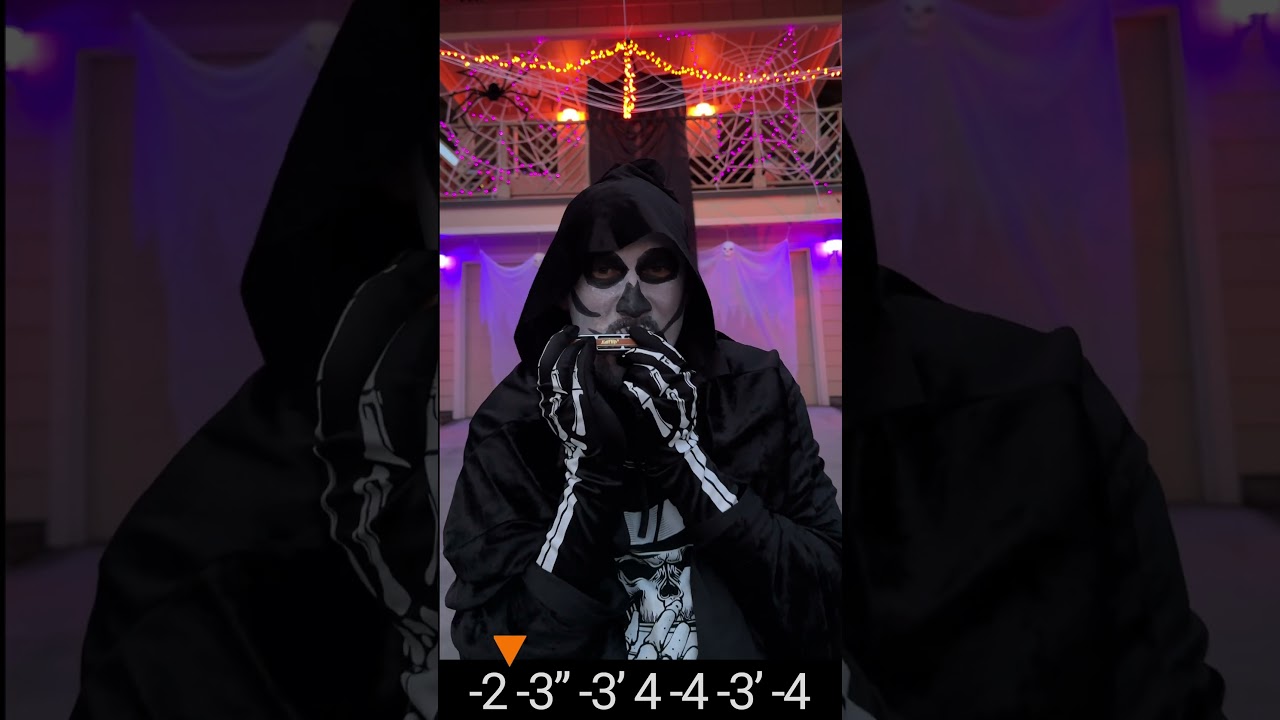
And of course, it’s absolutely vital for playing the wonderful composition “In the Hall of the Mountain King” as I demonstrated here in my past life as a skeleton:
The 1 and -1 notes seem to require a very light touch and are not played with any volume form what I can tell. I have one harp that plays the -1 well but light but other my other harp not so well. All are gapped the same. How do you play the -1? Is it always light and you max the volume inside your your mouth to play it?
I play one tune that starts with -2 -1 -2 -3 -2 and the first note is the biggest challenge. Bad to play a tune well when the first note is light and tough to play unless it is played well.


 and band can just continue their major fast blues-rock. It will fits nice


 I know!